What home heat and cold actually run at.

Temperatures, electrical loads, running ceilings and seller claims read directly from manuals and published reviews. Tap any figure for its source.

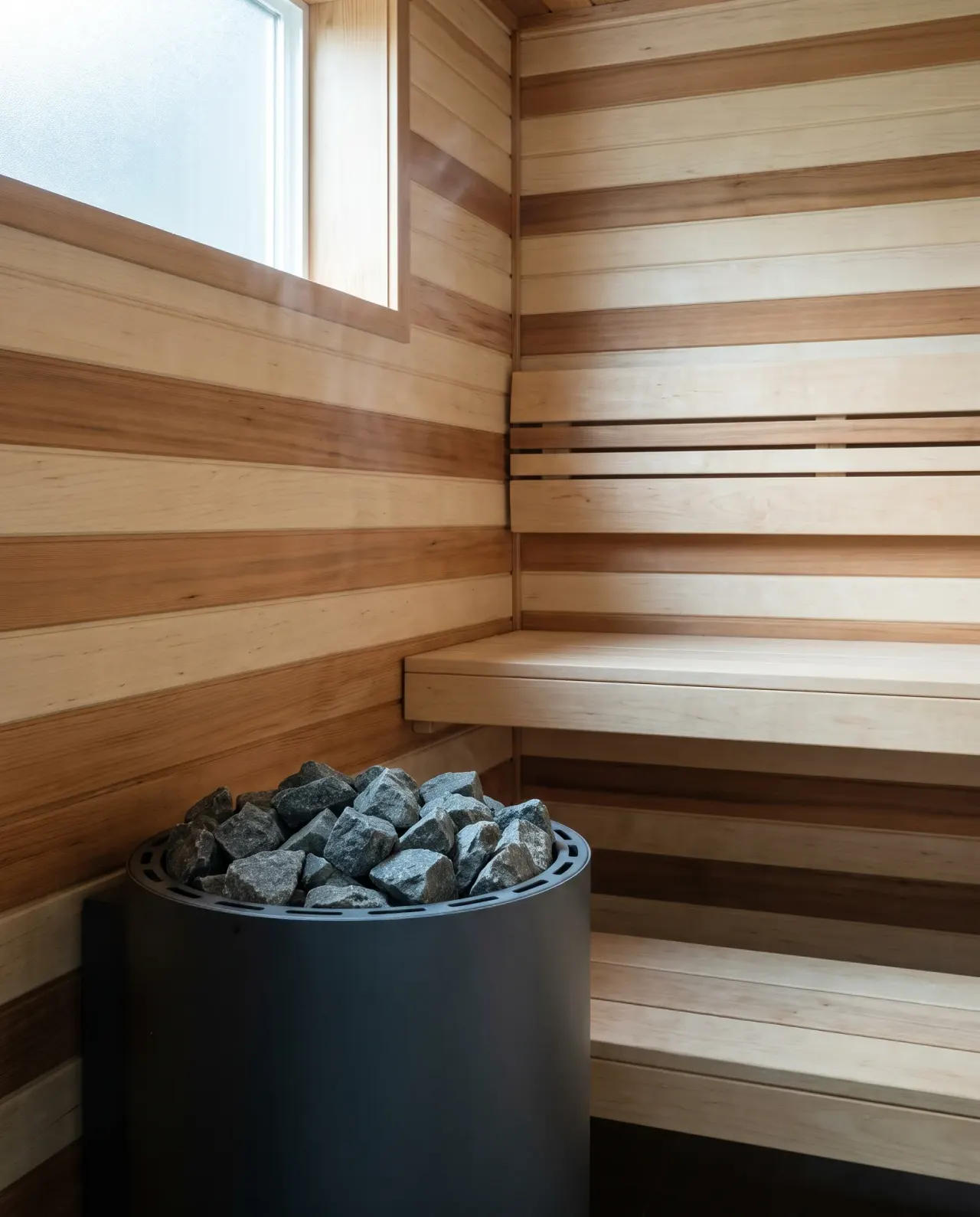
Interior of a timber sauna showing pale wood wall slats, two-tier benches, and an unbranded dark steel cylindrical heater packed with rough grey stones.
Stone mass radiates steady warmth after elements cycle off.
Scale cursor194°F · 90°CTraditional dry sauna band
  1. Cold plunge study57°F14°C

    Water temperature in the one-hour immersion study cited most in cold plunge marketing.

    Source

    Šrámek et al. 2000, PMID 10751106 · Study protocol

    Checked 22 Nov 2026 · Re-check 22 Nov 2027

    A protocol fact from the abstract. It describes head-out immersion of young men, not a typical home plunge. The Fahrenheit figure is our unit conversion.

    Open ledger entry [1]

  2. Carbon infrared panel140 to 150°F60 to 66°C

    Panel surface temperature reported in one seller's comparison of emitter types.

    Source

    Sun Home, full spectrum vs far infrared · Seller page

    Checked 22 Nov 2026 · Re-check 22 May 2027

    A seller's own analysis of emitter types, not an independent test.

    Open ledger entry [2]

  3. Traditional sauna air194 to 196°F90 to 91°C

    Dry sauna air temperature in a 2019 study of repeated sessions.

    Source

    Podstawski et al. 2019, PMID 30800676 · Study protocol

    Checked 22 Nov 2026 · Re-check 22 Nov 2027

    The temperature one study used, not a specification for home saunas. The Fahrenheit figure is our unit conversion.

    Open ledger entry [3]

Sourced temperatures plotted on the HeatClarity thermal scale
LabelFahrenheitCelsiusContextSource
Cold plunge study57°F14°CWater temperature in the one-hour immersion study cited most in cold plunge marketing.Šrámek et al. 2000, PMID 10751106
Carbon infrared panel140 to 150°F60 to 66°CPanel surface temperature reported in one seller's comparison of emitter types.Sun Home, full spectrum vs far infrared
Traditional sauna air194 to 196°F90 to 91°CDry sauna air temperature in a 2019 study of repeated sessions.Podstawski et al. 2019, PMID 30800676

The physical envelope

Stone, cedar, glass and winter air.

Every square metre of uninsulated glass or stone acts like extra room volume your heater has to warm.

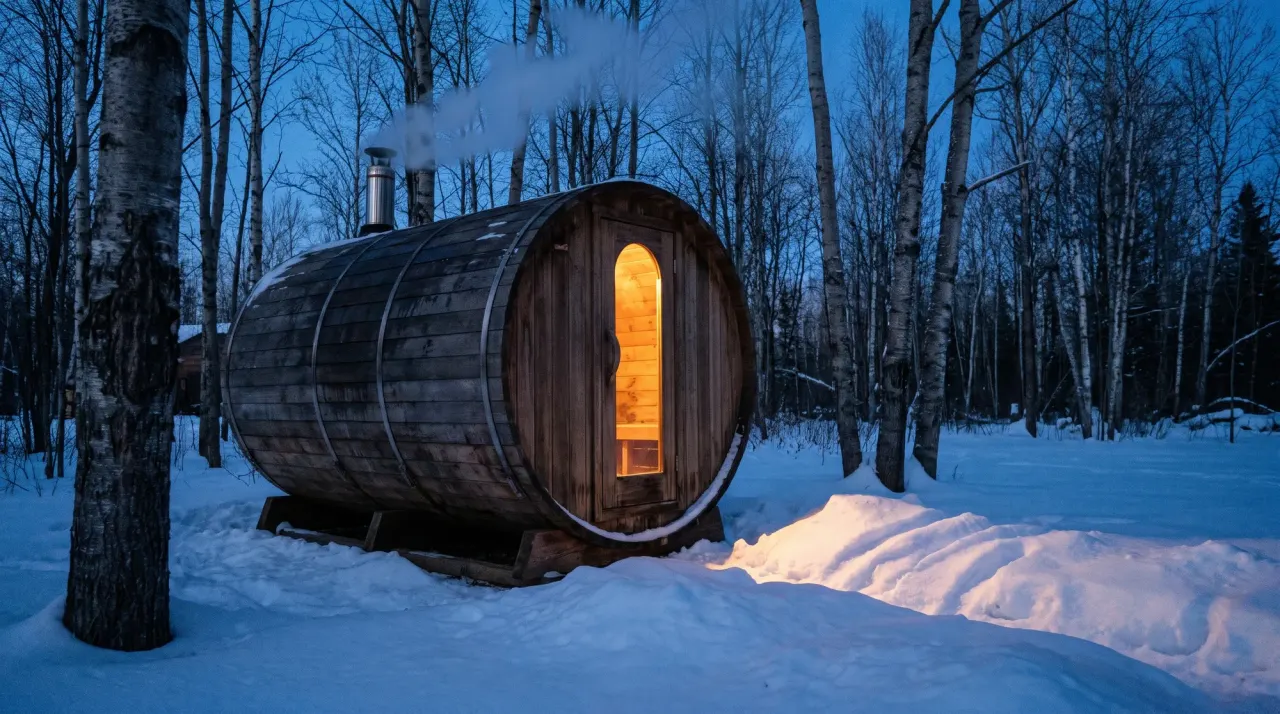
An unbranded wooden barrel sauna standing in deep backyard snow at twilight, warm light glowing through its small glass door with faint steam rising from the roof vent.
Outdoor cedar cabins lose heat rapidly through glass doors. HUUM's current US manuals count 1 m³ for each 1 m²Manufacturer manualChecked 22 Nov 2026HUUM DROP US manual (H1001L08 v8), Before installationHUUM has published other figures for the same rule (1.5 m³ per m² in older manuals), so the rule depends on which document is read.Re-check by 22 Nov 2027Full ledger of uninsulated glass, brick or tile as extra room volume; Harvia counts more.

Hardware we are sourcing

Manual specs first, photography once feeds are approved.

We never hotlink or copy manufacturer photography. Each drawing below shows the type of device, not the product, beside figures read from the primary document.

Electric sauna heater · primary manual specimenPhoto pending
HUUM HIVE 6

Rated at 6 kWManufacturer manualChecked 22 Nov 2026HUUM HIVE installation manual, Table 1Read from the PDF as text. The HIVE 9 row of the same table did not extract cleanly and is not used. The manual requires a certified electrician.Re-check by 22 Nov 2027Full ledger for a 5 to 8 m³ room, hard-wired on 240 V at 25 A by a certified electrician.

Drawing of a floor-standing sauna heater, not a product photo

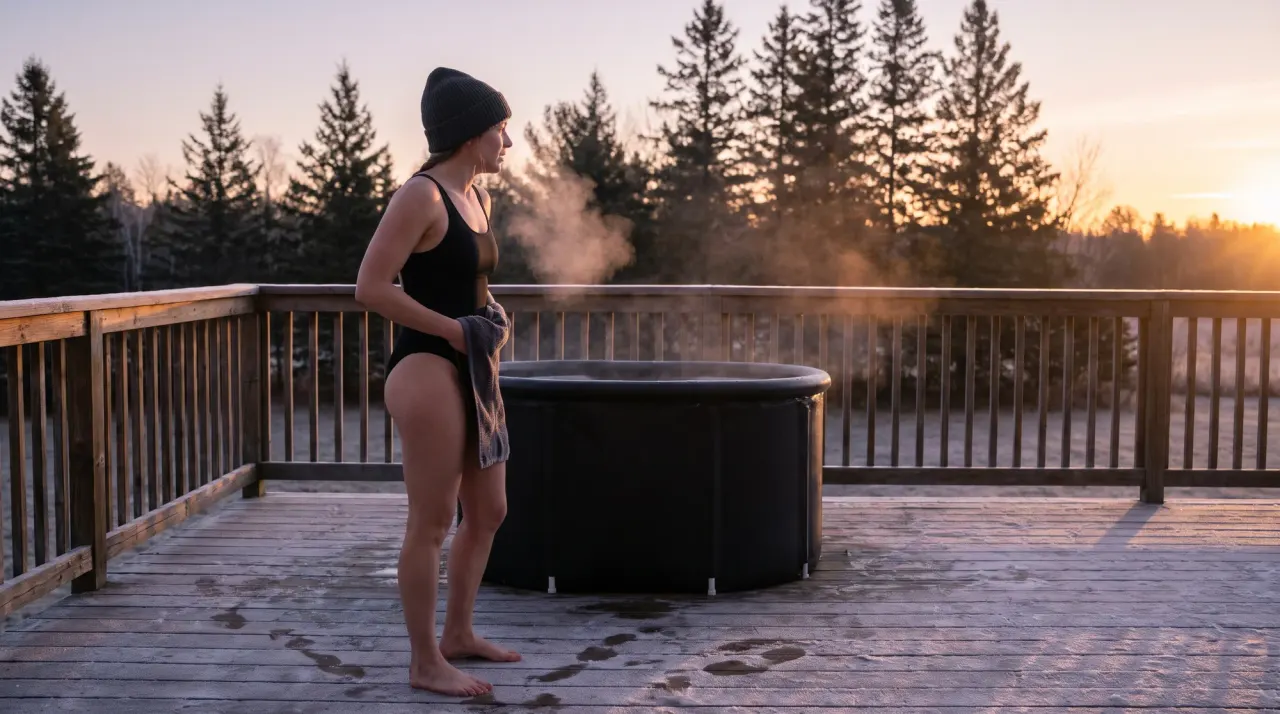
A woman in a wool knit hat and plain dark swimwear standing beside an unbranded matte slate cold plunge tub on a frosted timber deck in early morning mist.
The immersion protocol cited most in cold plunge marketing used 14°C (57°F) for one hourStudy protocolChecked 22 Nov 2026Šrámek et al. 2000, PMID 10751106A protocol fact from the abstract. It describes head-out immersion of young men, not a typical home plunge. The Fahrenheit figure is our unit conversion.Re-check by 22 Nov 2027Full ledger, far longer than a typical backyard dip.
Cold plunge chillerPhoto pending
Plunge Evolve Pro Chiller

Advertised minimum water temperature stays withheld until we read the primary spec page directly rather than a search snippet.

Drawing of a cold plunge chiller, not a product photo

Insulated plunge tubPhoto pending
Ice Barrel Cold Plunge

Chiller wattage and ice-retention specs stay off our calculators until sourced from primary product manuals.

Drawing of an upright cold plunge tub, not a product photo

Anatomy of one session

Why warm-up drives the bill, and why our calculator is a ceiling.

Stage 1 of 4 · Cold startNameplate load
Cold stones & cedar wallsElements draw full current on switch-onRoom at temp6 kW00m45 minSession endFull power warm-upThermostat cycles
  1. 01

    Switch on: full draw from minute zero

    A traditional heater like the HUUM HIVE 6 pulls 6 kWManufacturer manualChecked 22 Nov 2026HUUM HIVE installation manual, Table 1Read from the PDF as text. The HIVE 9 row of the same table did not extract cleanly and is not used. The manual requires a certified electrician.Re-check by 22 Nov 2027Full ledger across its 240 V elements the instant the relay closes. Nothing is cycling yet because the stone basket and cedar walls start cold.

  2. 02

    Warm-up stays pinned at 100%

    One dealer puts warm-up at 30 to 45 minutesSeller pageChecked 22 Nov 2026Sauna Place sizing guideA dealer statement, not a measurement. It does not give the starting temperature or the target.Re-check by 22 May 2027Full ledger for a correctly sized heater. Because the elements stay locked on to heat stone mass and air, warm-up frequently uses more electricity than sitting in the sauna afterward.

  3. 03

    Target air temperature reached

    In a 2019 study of repeated traditional sessions, sauna air ran at 90 to 91°C (194 to 196°F)Study protocolChecked 22 Nov 2026Podstawski et al. 2019, PMID 30800676The temperature one study used, not a specification for home saunas. The Fahrenheit figure is our unit conversion.Re-check by 22 Nov 2027Full ledger. By comparison, one seller reports carbon infrared panel surfaces at 140 to 150°FSeller pageChecked 22 Nov 2026Sun Home, full spectrum vs far infraredA seller's own analysis of emitter types, not an independent test.Re-check by 22 May 2027Full ledger, heating occupants directly rather than warming a large stone mass.

  4. 04

    Thermostat cycles below the ceiling

    Once hot, the thermostat cuts power on and off to hold temperature. Our running-cost math draws the flat dashed ceiling across the entire session because we have not metered the exact duty-cycle drop. Your real utility bill sits lower, inside the blue cycling trace.

    Model your warm-up vs session split

Electrical load & running cost

Start at the wall socket.

The sharpest practical divide between traditional and infrared saunas is electrical. One traditional heater manual requires 240 VManufacturer manualChecked 22 Nov 2026HUUM HIVE installation manual, Table 1Read from the PDF as text. The HIVE 9 row of the same table did not extract cleanly and is not used. The manual requires a certified electrician.Re-check by 22 Nov 2027Full ledger at 25 A, while small infrared cabins are sold for a standard 120 V, 15 A outlet, with larger models on a dedicated 20 A circuitSeller pageChecked 22 Nov 2026Heavenly Heat guide to plug-in infrared saunasOne seller describing the category, not a nameplate. The page gives three wattage ranges that do not agree with each other.Re-check by 22 May 2027Full ledger.

Drag the sliders to compare monthly electricity ceilings across sourced nameplates at your own utility rate.

75 min
20 min150 min
4 / wk
1 / wk14 / wk
0.18 / kWh
0.060.55
Monthly electricity ceilingYour currency · full nameplate draw
Traditional electric heaterHUUM HIVE 6 (6 kW)
0.00 / mo0.00 / session · 0 kWh
Plug-in infrared, 15 A limit1.8 kW (120 V x 15 A max)
0.00 / mo0.00 / session · 0 kWh
Plug-in infrared, seller low1.2 kW (seller range low)
0.00 / mo0.00 / session · 0 kWh

Ceiling arithmetic only. The rate starts at the US residential average, United States average: 18.19 cents per kWh, residential average, January to August 2026Government statisticsChecked 22 Nov 2026EIA Electric Power Monthly, Table 5.6.BAn average revenue per kWh, not a tariff: EIA divides residential revenue (energy, demand and service charges, surcharges, fuel adjustments and utility taxes) by kWh sold, so it is not the rate any one household pays.Re-check by 22 Feb 2027Full ledger (EIA); use the rate on your bill. Thermostats cycle off once hot, and we have not metered the drop. Power figures come from the HUUM manual (6 kWManufacturer manualChecked 22 Nov 2026HUUM HIVE installation manual, Table 1Read from the PDF as text. The HIVE 9 row of the same table did not extract cleanly and is not used. The manual requires a certified electrician.Re-check by 22 Nov 2027Full ledger) and one seller's plug-in wattage range (1,200 to 1,800 WSeller pageChecked 22 Nov 2026Heavenly Heat guide to plug-in infrared saunasThe same page also states 1.2 to 2.0 kW and 1,500 to 2,500 W. Use the nameplate of the model you are pricing.Re-check by 22 May 2027Full ledger).

Monthly electricity ceiling comparison
Sauna typePowerMonthly ceilingPer session
Traditional electric heater6 kW0.000.00
Plug-in infrared, 15 A limit1.8 kW0.000.00
Plug-in infrared, seller low1.2 kW0.000.00

Marketing claims register

18 repeated seller claims. Zero fully supported.

Every recurring spec and body claim plotted on one verdict axis, split between hardware specs and claims about the body. Hover or tap any mark to read the finding.

Read the full claims register
0SupportedThe sources we read back the claim as sellers word it.
10MixedTrue in some conditions, or the sources disagree.
7OverstatedA real figure or effect, stretched past what the source shows.
1UnsupportedNo source we could find backs the claim as worded.
Published finding Verdict assigned, finding in reviewHover or tap any numbered mark to inspect the claim
Supported0
Mixed10
Overstated7
Unsupported1
Spec & electrical10 claims
Body & health8 claims
Claim 4 of 18
Claim #4Published finding

Size a sauna heater at 1 kW per 45 to 50 cubic feetSpec claim, as marketed

Mixed

Disputed. One dealer gives 1 kW per 45 cu ft, given as a starting point; another says 1 kW per 50 cu ft lands at the top of the makers' printed ranges and leaves little or no margin. HUUM sizes at 1 kW per calculated m³ (about 35.3 cu ft), and Harvia's support page also gives Harvia: on average 1 kW of heater power for each m³ of sauna volume, which is a larger heater for the same room. The makers disagree on glass: Harvia counts Harvia: each m² of stone, glass or similar non-insulated surface counts as 1.2 m³ of extra room volume; HUUM's current US manuals say HUUM: add 3.3 cu ft of room volume for each 1 sq ft of uninsulated brick, tile or glass wall, or 1 m³ for each 1 m²; an older HUUM manual still online adds 1.5 m³ per m² (about 4.92 cu ft per sq ft). A second reviewer rated the rule supported as a baseline for insulated indoor rooms. We do not pick a winner: we quote each maker's table.1314156745

Checked 22 Nov 2026 · Read in claims register
Not medical advice

This section reports what published systematic reviews found. It is not advice for your body or your condition. Talk to a clinician before using heat or cold if you are pregnant, take medication or have a medical condition.

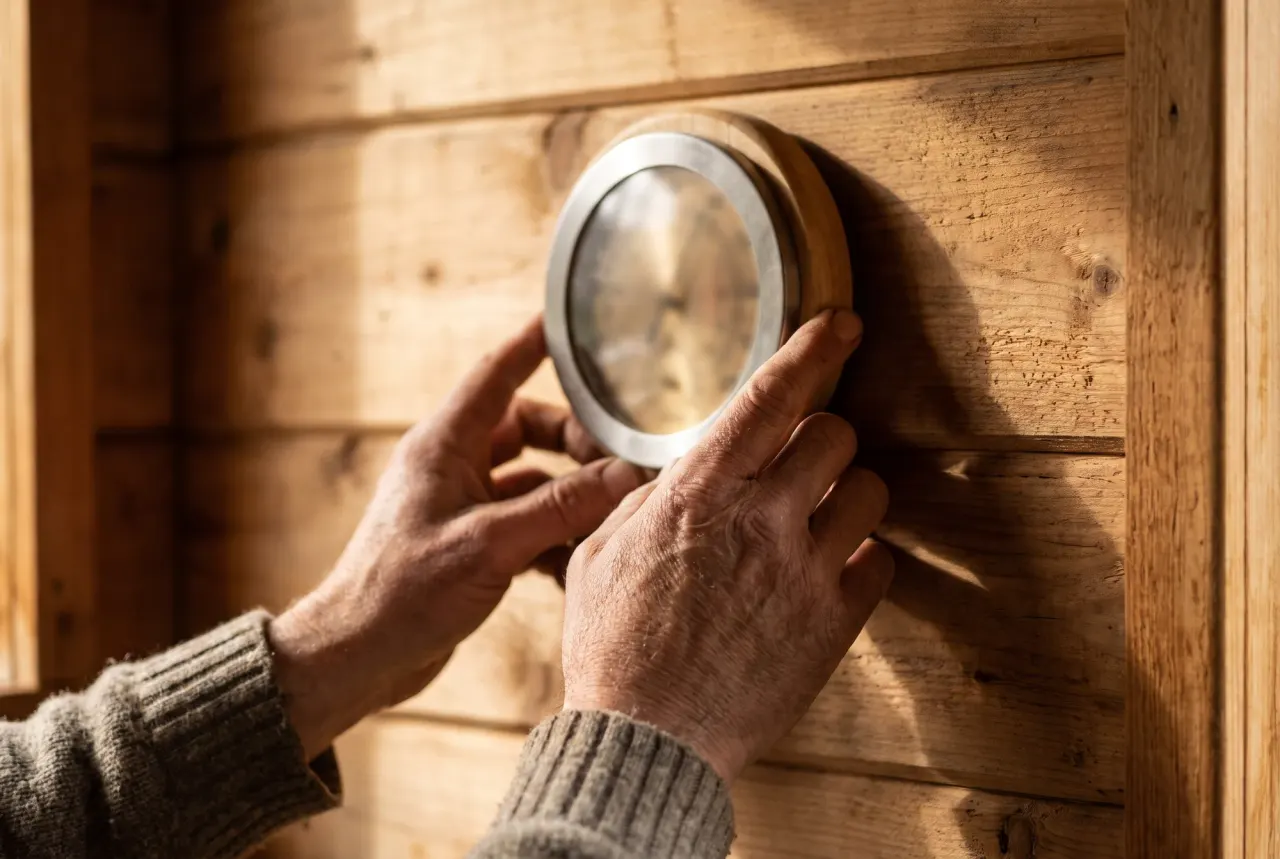
Close-up of a person checking an unbranded brushed steel and wood dial thermometer mounted on a vertical cedar sauna wall in warm morning light.
Every figure carries a check date and an expiry window. When a record ages out, the number drops off the page until it is read again.

How HeatClarity works

Zero paid links today. Every body statement cites a systematic review.

We applied to 8 affiliate programmes. None has approved us yet, so nothing on this site earns a commission today. Approved links appear only where a merchant pays in your country, marked beside the link.

Any statement about the body on HeatClarity reports a cited systematic review or meta-analysis, never a seller brochure. More guides on barrel sauna costs, heater sizing and cold plunge chillers are in research and publish only once every figure is read from its primary document.

AUDIT TRAILSources and verification ledger for this page16 primary records · Checked 22 Nov 2026
  1. Water temperature and duration in the immersion study most cold plunge marketing cites
    Šrámek et al. 2000, PMID 10751106. Study protocol. Checked 22 Nov 2026, re-check by 22 Nov 2027.
    "a group of young men was examined during 1-h head-out immersions in water of different temperatures (32 degrees C, 20 degrees C and 14 degrees C)."
    Limit: A protocol fact from the abstract. It describes head-out immersion of young men, not a typical home plunge. The Fahrenheit figure is our unit conversion.
  2. Surface temperature of carbon infrared panels
    Sun Home, full spectrum vs far infrared. Seller page. Checked 22 Nov 2026, re-check by 22 May 2027.
    "Standard carbon panels operate at 140–150°F surface temperature."
    Limit: A seller's own analysis of emitter types, not an independent test.
    Another source disagrees: 130 to 150°F. Peak Saunas low EMF infrared sauna guide.
  3. Air temperature of the traditional sauna in a 2019 study of repeated sessions
    Podstawski et al. 2019, PMID 30800676. Study protocol. Checked 22 Nov 2026, re-check by 22 Nov 2027.
    "were exposed to four sauna sessions of 10 minutes each (temperature: 90-91°C; relative humidity: 14-16 %)"
    Limit: The temperature one study used, not a specification for home saunas. The Fahrenheit figure is our unit conversion.
  4. HUUM rule for uninsulated brick, tile or glass walls (current US manuals)
    HUUM DROP US manual (H1001L08 v8), Before installation. Manufacturer manual. Checked 22 Nov 2026, re-check by 22 Nov 2027.
    "In case there are any uninsulated brick, tile, or glass walls in the sauna room, an additional 3.3 ft³ must be added to the sauna room volume for each 1 ft² of such wall; or 1 m³ for each 1 m²."
    Limit: HUUM has published other figures for the same rule (1.5 m³ per m² in older manuals), so the rule depends on which document is read.
    Another source disagrees: 53 cu ft (1.5 m³) per m² of uninsulated wall. Older HUUM HIVE manual PDF hosted on a retailer Shopify CDN.
    Another source disagrees: 4.92 cu ft per sq ft of cold surface. Sizing Your HUUM 2023 sheet on a retailer Shopify CDN.
    Another source disagrees: coefficient k of 1 per m² of glass or log wall. HUUM article on dimensioning a sauna heater.
  5. Older HUUM HIVE manual (a retailer-hosted copy): extra room volume per square metre of uninsulated glass, brick or tile
    HUUM HIVE installation manual, older edition hosted by a retailer. Manufacturer manual. Checked 22 Nov 2026, re-check by 22 Nov 2027.
    "In case there are any uninsulated brick, tile or glass walls in the sauna room, an additional volume of 53 ft³ (1.5 m³) should be added to the sauna room for each such square meter of the wall."
    Limit: An older edition. HUUM's current US manuals and its sizing article use 1 m³ per m², so HUUM's documents disagree. The manual states that a wrongly sized heater voids the warranty.
    Another source disagrees: 1 m³ per m² (coefficient k = 1). HUUM article, How to dimension a sauna heater.
    Another source disagrees: 3.3 cu ft per sq ft, or 1 m³ per m². HUUM DROP US user manual (2026).
  6. Harvia support: heater power per cubic meter
    Harvia support article "How do I select the correct heater power". Manufacturer page. Checked 22 Nov 2026, re-check by 22 May 2027.
    "An average of 1 kW of heater power is required for each cubic meter of sauna volume (1 m³ = 1 kW)."
    Limit: An average; Harvia also says to pick a heater near the middle of its own min to max range.
  7. Harvia support: stone or glass surface adder
    Harvia support article "How do I select the correct heater power". Manufacturer page. Checked 22 Nov 2026, re-check by 22 May 2027.
    "One square meter of stone, glass or similar non-insulated surface increases the heater power requirement as much as if the sauna room volume were increased by 1.2 cubic meters."
    Limit: Harvia's calculator and manuals apply this; other makers use other figures for the same surfaces.
  8. HUUM HIVE 6 electric heater: power, room volume and supply
    HUUM HIVE installation manual, Table 1. Manufacturer manual. Checked 22 Nov 2026, re-check by 22 Nov 2027.
    "HIVE 6 6 176.6-282 ft3 2 25 30 10 [...] 5-8 m3"
    Limit: Read from the PDF as text. The HIVE 9 row of the same table did not extract cleanly and is not used. The manual requires a certified electrician.
  9. Warm-up time for a correctly sized traditional electric heater
    Sauna Place sizing guide. Seller page. Checked 22 Nov 2026, re-check by 22 May 2027.
    "a properly sized heater typically brings the sauna to temperature in about 30–45 minutes, instead of struggling for an hour or more."
    Limit: A dealer statement, not a measurement. It does not give the starting temperature or the target.
  10. Supply that 1 and 2 person plug-in infrared cabins are sold for
    Heavenly Heat guide to plug-in infrared saunas. Seller page. Checked 22 Nov 2026, re-check by 22 May 2027.
    "Most 1- and 2-person plug-in infrared saunas are built to operate on a standard 120V, 15-amp, three-prong household outlet. [...] Slightly larger models, such as the GSE-2, GSE-3, GSE-3C, and GSE-4, usually require a dedicated 110-volt outlet rated for 20 amps."
    Limit: One seller describing the category, not a nameplate. The page gives three wattage ranges that do not agree with each other.
  11. Wattage range one seller gives for plug-in infrared cabins
    Heavenly Heat guide to plug-in infrared saunas. Seller page. Checked 22 Nov 2026, re-check by 22 May 2027.
    "Most home infrared saunas use between 1,200 and 1,800 watts, about the same as common household appliances."
    Limit: The same page also states 1.2 to 2.0 kW and 1,500 to 2,500 W. Use the nameplate of the model you are pricing.
    Another source disagrees: 1.2 to 2.0 kW. Same page, a different paragraph.
    Another source disagrees: 1,500 to 2,500 W. Same page, a different paragraph.
  12. Magnetic field figures one brand publishes for its infrared cabins
    Sun Home summary of Vitatech report VTE-3534 (January 2025). Test report, brand commissioned. Checked 22 Nov 2026, re-check by 22 May 2027.
    "| 1 foot | 0.6 – 4.0 mG | Lower than a common kitchen toaster | [...] | 2 feet | 0.4 – 1.8 mG | Near-background levels | [...] | 3 feet (typical position) | 0.3 – 0.9 mG | Virtually background | [...] AC ELF magnetic field, RMS, 10–3,000 Hz, measured with a laboratory-grade fluxgate magnetometer with the heating element under load"
    Limit: The test was commissioned by the brand and is quoted from the brand's summary. Measured as RMS from 10 to 3,000 Hz with heaters under load.
    Another source disagrees: 0.1, 0.5 and under 1 mG, with no distance stated. Sunlighten low EMF page.
  13. Dealer rule of thumb for heater size
    Sauna Supply Co, choosing the right size heater. Seller page. Checked 22 Nov 2026, re-check by 22 May 2027.
    "The basic math everyone throws around is 1 kilowatt per 45 cubic feet. That’s your starting point, but it’s just that – a starting point."
    Limit: A dealer page, not a manual. The same page says the real need depends on glass, insulation and climate, and adds about 1 cu ft per sq ft of glass.
    Another source disagrees: 1 kW per calculated m³ (about 35.3 cu ft). HUUM article, How to dimension a sauna heater.
  14. What one dealer says about the 1 kW per 50 cu ft rule
    Sauna Place sizing guide. Seller page. Checked 22 Nov 2026, re-check by 22 May 2027.
    "A 1 kW per 50 cubic feet rule lands at the top of those ranges (for example, the HUUM DROP 9 tops out at 460 ft³ and the Harvia KIP 45 at 210 ft³), so it leaves little or no margin."
    Limit: A dealer page, not a manual. It tells readers to use each heater's printed range rather than any single rule.
  15. HUUM sizing rule
    HUUM article, How to dimension a sauna heater. Manufacturer page. Checked 22 Nov 2026, re-check by 22 May 2027.
    "One calculated cubic meter presumes one kilowatt of the heater’s power."
    Limit: The calculated volume includes the adders for glass, log and uninsulated walls. The cu ft figure is our unit conversion.
  16. Average residential electricity price, United States (all states and DC)
    EIA Electric Power Monthly, Table 5.6.B. Government statistics. Checked 22 Nov 2026, re-check by 22 Feb 2027.
    "| U.S. Total | 18.19 | 17.03 | 14.04 | 13.29 | 9.09 | 8.50 | 15.64 | 13.73 | 14.37 | 13.50 |"
    Limit: An average revenue per kWh, not a tariff: EIA divides residential revenue (energy, demand and service charges, surcharges, fuel adjustments and utility taxes) by kWh sold, so it is not the rate any one household pays.